
Thursday, March 5, 2009

Not a Tame Lion


My favorite quote from The Lion, the Witch and the Wardrobe is from the conversation between Susan, Lucy and Mr. and Mrs. Beaver when they meet. Susan asks if this Aslan is quite safe because she feels she'll be rather nervous about meeting Him. Mrs. Beaver says that only a silly person could stand before Aslan without their knees knocking.

"Then he isn't safe?" said Lucy.
"Safe?" said Mr. Beaver; "don't you hear what Mrs. Beaver tells you? Who said anything about safe? 'Course he isn't safe. But he's good. He's the King, I tell you."

(This has sunk into the being that is me and often recalled. This notion is even more understood from reading Book 1 in Mere Christianity, also by Lewis, which I and a friend are reading together.)

(Thanks for indulging me :-) ) So, I said all that to say that I found a book called Not a Tame Lion which OF COURSE caught my eye!! It is a book about the Spiritual Legacy of C. S. Lewis by Terry Glaspey. (For those George Grant fans, Grant wrote the forward!!)

I love the angle of this book. It is part biography intertwined with the messages of the writings of Lewis. What a brilliant idea!

So, I'll probably comment more about this book, but I'll leave Chronicles of Narnia fans with this one fact. Did you know that Lewis and his housemates opened their home to evacuated children during the war? (just like in The Lion, Witch and the Wardrobe!!!) Glaspey states that this is probrably the insite it took for Lewis to be able to write such wonderful children's Literature!

Thursday, February 26, 2009

The Village on The Hill: A Story of the Church Conflict in Germany

I have just finished a very moving and perhaps even convicting book published in English in May of 1940. The Village on The Hill: A Story of the Church Conflict in Germany is a true account of the village of Lindenkopf just before and after Hitler came to power and the Nazi regime began to control Germany.

The old pastor of the local German Christian Church retired and a new younger pastor was sent to the village. Peter Holzschuh, a woodman and member of the church council, had been in the military with Pastor Stefan Grund during the first world war.

The church had previously been content to attend services on Sunday with little or no impact on their daily lives, though they are upstanding people. However, Pastor Grund began to call their attention back to the Word, eventually even holding extra Bible classes to teach the people.

Slowly, but surely, this town, fairly disconnected from the outside world before, began to see the effects of the Nazi regime in their small village. Gradually, the German Christian Church was infiltrated and the upper leadership replaced with members of the National-Socialist Party. A separation became necessary and the Confessing Church was formed, which declared that it stood on the Word of God alone. I will not spoil the story for any who have the opportunity to read this book, so, this is my only introduction!

I have never read anything about the Christian church during this time, I confess. The story of their struggle is amazing. It reminds me that we must all "be prepared in and out of season", learning to love God and studying Him through His Word. We must be ready to stand on His Word and trust him alone for our salvation, else we also could fall prey to looking for the salvation of our nation and all that we hold dear in man and government. We pray for our government and obey its laws to the extent that they do not go against the Word of God. His Word endures forever.

I leave with one quote from the book:

This was the sort of thing we felt that our fathers had endured; they, too, had gathered together that God's Word might not be taken from them; they, too, had sung the battle-songs of the Gospel in the face of their enemies. Hundreds of years had passed since the Reformation, floods of water had rolled down our millstream since then, plagues and wars and revolutions had broken over our village, new things had come in and old things died out; but the Word of God had not died; we could see once again how much it was alive.

Saturday, February 14, 2009

Children are Persons

"I have never, as far as I can remember, given one moment's thought as to whether any drawing that I was doing was for adults or children. I have never changed one conception or line or detail to suit the supposed age of the reader. And I have never, in what writing I have done, changed one word or phrase of text because I felt it might be over the heads of children. I have never, I hope, insulted the intelligence of any child. And with God and my publishers willing, I promise them that I never will."

Robert Lawson
Author of Rabbit Hill

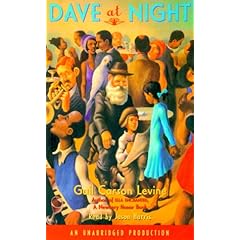
Dave at Night


Dave at Night was written by Gail Carson Levine. She also wrote Ella Enchanted. Dave is a "rascal" as his dad calls him, growing up in NYC. His mom died when he was born, but his life is turned upside down when his father dies when he is eleven.

Since all of his family is poor and he is a rambunctious little boy, no relatives will take him, but his "genius" brother is taken in by an uncle. His step mom takes him to the Hebrew Home for Boys or the HHB. The home is not exactly the loving place outsiders imagine it to be. Dave discovers quickly that is a hard place to live. But, soon he sneaks out and meets Solly, Ira and the night life in Harlem of the 1920's. He returns in the morning to the HHB, but meets with the wrath of the Superintendent who thinks they caught him trying to run away instead of coming back.

I felt like I was with Dave as he walked through his emotions trying to understand the life around him and discover his "gift". His story did not end the way I wanted it to, but it ends the way he wants it to! ENJOY!

Wednesday, February 11, 2009

Quote from Wind in the Willows


The boys are reading Wind in the Willows right now and we came across a powerful quote I just had to post. The field rat is speaking to the Water Rat:

"It is a goodly life that you lead, friend; no doubt the best in the world, if only you are strong enough to lead it!"

And I echo, "I can do all things through Christ who strengthens me." Philippians 4:13

Knowing God by J I Packer


Some things really struck me just now as I am reading the preface and Ch 1 of J I Packer's Knowing God. He writes:

In A Preface to Christian Theology, John Mackay illustrates two kinds of interest in Christian things by picturing persons sitting on the high front balcony of a Spanish house watching travelers go by on the road below. The "balconeers" can overhear the travelers' talk and chat with them; they may comment critically on the way that the travelers walk; or they may discuss questions about the road, how it can exist at all or lead anywhere, what might be seen for differnt points along it, and so forth; but they are onlookers, and their problems which, though they have their theoretical angle, are essentially practical-problems of the "which-way-to-go" and "how-to-make-it" type, problems which call not merely for comprehension but for decision and action too.

Balconeers and travelers may think over the same area, yet their problems differ. Thus (for instance) in relation to evil, the balconeer's problem is to find a theoretical explanation of how evil can consist with God's sovereignty and goodness, but the traveler's problem is how to master evil and bring good out of it. Or again, in relation to sin, the balconeer asks whether racial sinfulness and personal perversity are really credible, while the traveler, knowing sin from within, askes what hope there is of deliverence. Or take the problem of the Godhead; while the balconeer is asking how one God can conceivably be three, what sort of unity three could have, and how three who make one can be persons, the traveler wants to know how to show proper honor, love an dtrust toward the three Persons who are now together at work to bring him out of sin to glory. And so we might go on.

I am really struck by the explanation of this. It makes perfect sense to me as a traveler. Balconeers might say, "How do you know that God is even there?" But His children say, "I just know He is!" Even when I struggled as a child with doubting my salvation because of the wickedness I still saw in myself, when I stopped worrying and looked to God, I had no doubt that I knew Him and had sensed his Presence and known His work in my life. The thing is, one can never know this from looking on "from the balcony" so to speak. But those who truely know God, though doubts and fears may assail us from time to time, know that we know.

And then Packer goes on tosay:

My proposal is this. You will know how (John) Bunyan's pilgrim (in Pilgrim's progress), when called back by his wife and children from the journey on which he was setting out, "put his finders in his ears, and ran on crying, Life, Life, Eternal Life." I ask you for the moment to stop your ears to those who tell you there is no road to knowledge about God, and come a little way with me and see. After all, the proof of the pudding is in the eating, and anyone who is actually following a recognized road will not be too worried if he hears nontravelers telling each other that no such road exists.

Saturday, February 7, 2009

Her Children Arise Up and CALL HER BLESSED


I just finished a good book on Motherhood. It was published by Castleberry Farms Press, the people who brought us the wonderful courtship series. Mr. and Mrs. Steven Castleberry write of memories of their own godly mother and grandmother and the examples they lived. There are chapters on motherly attention, being compassionate to others, showing genuine love for your children, fearing the Lord, being content with what you have, being cheerful, being home, loving your husband, prefering others and children's praise of their mothers.